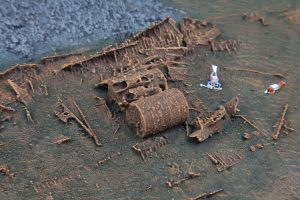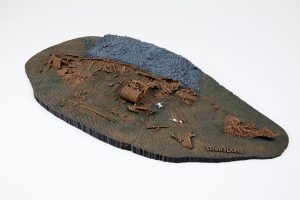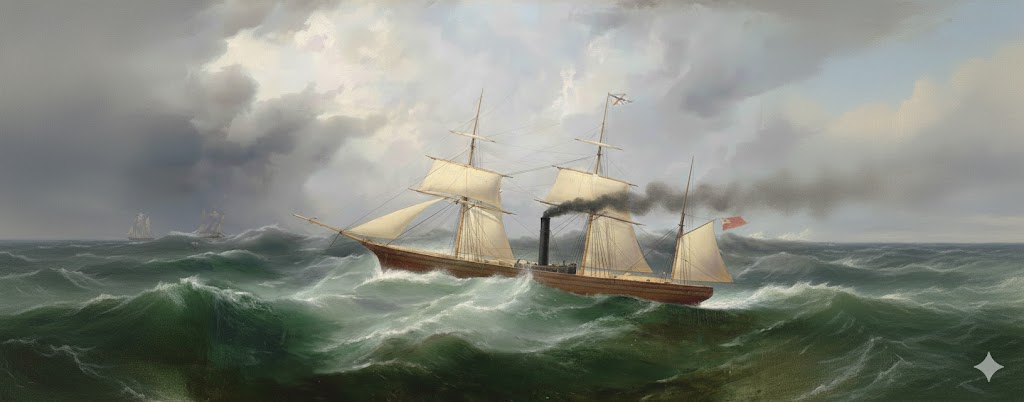
San Quentin (also known as San Quintín or “The Sunken Tin”).
At the eastern entrance of Subic Bay in the Philippines, southeast of Chiquita and Grande Islands, lies the historic wreck of the former British mail steamer. She was later modified into an Spanish armed transport.
This ship was driven by sails and a steam machine with two boilers. The intriguing wreck rests at a depth of 16 meters, making it accessible to divers of all experience levels. The vessel was deliberately scuttled in 1898 to block the bay from the advancing American Navy.
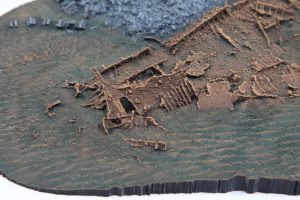
Much of the bow, the boilers, and the stern—including the large rudder—remain intact, while the rest of the hull is scattered across the sandy seabed, resembling the fragile skeleton of a long-forgotten ship. One of the most popular dives sites with underwater photographers and videographers in Subic Bay.


History
The vessel later known as the Spanish armed transport San Quintín began her career as the British mail steamer S/S Andes. She was built in 1852 as one of four nearly identical iron screw steamships ordered by the British and North American Royal Mail Steam Packet Company (later associated with the Cunard Line). Designed to carry passengers, mail, and cargo on the Liverpool–New York route, these ships represented the transition from paddle steamers to more modern screw-propelled iron vessels.
The four identical ships were built by the Scottish ship builder William Denny & Brothers. The names were Andes, Alps, Australia and Sydney. The ships were listed as 1275 grt/866 nrt , the length of 236.6 feet (72 meters), beam of 33.2 feet (10.1 meters) and depth of 24 feet (7.3 meters). The ships were mail ships. These were basically passenger ships that also operated under a contract to transport mail. The ships were design to carry 62 passengers in first class and 122 in second class.
During the Crimean War (1853–1856), the Andes was chartered by the British government and used for troop transport and medical evacuation. This early military service demonstrated the versatility of the ship and foreshadowed her later career under a naval flag.
In 1859, the Spanish government purchased the Andes and converted her for use as an armed transport, renaming the vessel San Quintín. Although never a true warship, she was equipped to carry troops, supplies, and government personnel across Spain’s overseas territories. A sister ship, formerly the Alps, entered Spanish service under the name Mandingo.
Throughout the second half of the 19th century, the San Quintín operated extensively within the Spanish colonial network. Historical references place her in the Caribbean, including Cuba in the early 1860s, where she transported wounded soldiers and military supplies. In later decades, she served in the Pacific, supporting Spanish administration and logistics in Micronesia and the Philippines. Records mention her presence at Yap in the 1880s, where she helped deliver officials and materials for colonial governance, illustrating her role as a mobile lifeline between distant Spanish possessions.
By the 1890s, the aging San Quintín was primarily employed as a transport and auxiliary vessel in the Philippines. When the Spanish–American War broke out in 1898, Spain’s Pacific squadron faced overwhelming American naval power. To deny the enemy access to the strategic anchorage of Subic Bay, Admiral Patricio Montojo ordered several obsolete vessels to be scuttled as blockships. On March 15, 1898, the San Quintín was deliberately sunk to obstruct the channel into the bay.
Today, the wreck of the San Quintín lies in Subic Bay in the Philippines, partially buried in sand and heavily eroded by time and storms. Long misidentified by divers as a gunboat, the site is now recognized as the remains of a former mail steamer turned Spanish armed transport. The wreck stands as a tangible reminder of late 19th-century colonial logistics, the decline of Spain’s Pacific naval power, and the dramatic final chapter of the ship’s long and varied service life.
Sources: Link
Looting
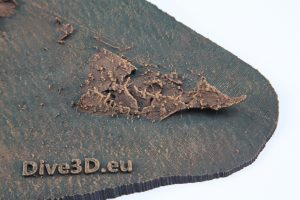
It is reported that looters used homemade dynamite and hookah diving equipment to systematically strip the site of valuable materials. Their main targets were the copper lining of the wreck’s massive boilers and large sections of metal from the ship’s midsection.
The central structure of the vessel, once made up of heavy metal spars covered in dense hard and soft coral growth, was completely destroyed. These sections were blown apart with explosives and removed piece by piece for sale as scrap metal. Local divers estimate that more than 30 tonnes of metal were illegally taken from the site. What remains of the wreck’s midsection is now little more than a disturbed patch of seabed, scattered with shattered fragments of rusted metal.
The Dive
I dived and scanned the wreck on January 13th 2026


The model
You can get the STL files for printing in my Shop